What has been announced
In April 2026 the Government of Dubai announced a fourth metro line, the Gold Line — the largest expansion of the network since it opened. It runs 42 kilometres with 18 stations, and the entire route is underground; on the red and green lines, tunnelled sections are the exception.
The line will connect the red and green lines to each other and interchange with Etihad Rail. The network grows by roughly a third, and the new stations put districts housing around one and a half million people within walking distance of a train.
The stated budget is about nine billion dollars. The launch date follows the metro’s house style: 9 September 2032 — the red line opened on 09.09.2009, the blue line is promised for 09.09.2029.
Keep the project’s status in mind: this is an announcement with a date, not a construction site with finished tunnels. Alignment and station lists can shift before work starts — with the blue line they did exactly that.
Where it goes
The route’s defining feature is that it runs through districts that have no rail at all. The red line serves Sheikh Zayed Road, the green line the old city; the Gold Line goes where today’s buyer can only drive.
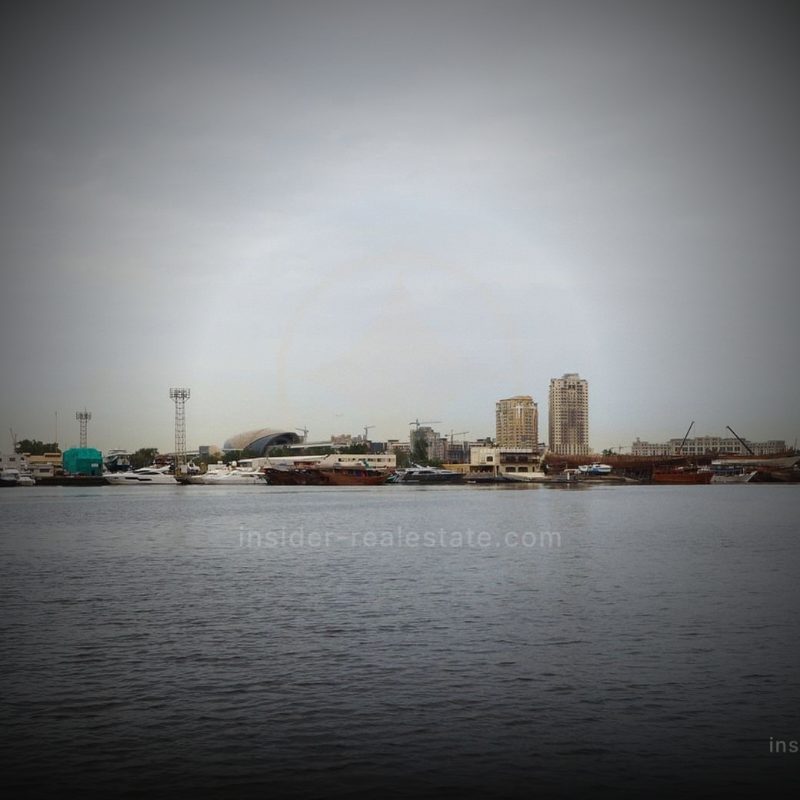
On the coast that means Dubai Maritime City and Mina Rashid — two new waterfront districts building out fast on a single access road. The line then passes through Business Bay, the only stretch of the route the metro already serves.
The main gains sit mid-route: Meydan and MBR City, where Meydan Horizon is under construction, then Dubai Hills Estate. These are large, expensive, already-inhabited territories for which a metro station was always “someday”.
The route closes with JVC, JVT and Production City — the city’s biggest mass-apartment districts, where transport was the main argument against. For them, an underground line changes the position more than for anyone else.
What it does to prices
The rule established on the red line repeats unchanged: buyers pay full price for a working station; the money is made on the station that does not exist yet. Per CBRE, housing within fifteen minutes’ walk of metro stations had grown 43.8% by 2022 against 2010.
Part of that growth belongs to the locations the stations were put in rather than to the stations themselves. But the direction is robust and rent confirms it: a flat near the metro lets faster and sits empty less, and on a long horizon vacancy eats yield harder than the rate does.
What makes the Gold Line specific is that almost all of it runs through districts discounted precisely for the commute. In JVC and Production City that transport discount is in the price right now — and it is what the line’s launch should close.
The other side is time. Launch is six years out, and until then the money works only on the district’s general growth, with no station effect. This is a position for patient capital, not a quick trade.
How to play it
The blue line, launching in 2029, is closer, and its effect arrives sooner — between two lines with the same logic, the calendar argues for it. The Gold Line is the next wave of the same strategy: a deeper discount and a longer wait.
Developers are already selling the future line: projects in Meydan and MBR City, in Maritime City and along the southern stretch cite it in presentations alongside built infrastructure. Part of an effect that does not exist yet is already in the price list.
So the working question is not “will there be a station nearby” but “how much is already being charged for it”. Compare a “next to the future station” project with the neighbouring building without one: a double-digit gap means you are buying someone else’s calculation, not growth.
And run the numbers without the line. A district that works without a station is the right bet — the metro arrives as a bonus. A district held up only by the promise of a tunnel stays a promise if the schedule slips.
What to check
The project’s status at the time of your deal: announcement, construction contract, or works underway. Years separate those stages, and the price of waiting differs in each.
The location of the specific station once it is published. “A district on the Gold Line” and “ten minutes’ walk to the entrance” are different premiums — and in districts the size of Dubai Hills, fundamentally different ones.
And the slack in your own plan. If you may need the money before 2032, the line’s effect will accrue to the next owner — and paying for it upfront would be a mistake.

 Dubai Metro
  Burj Khalifa
  Al Maktoum International
  Dubai Tram
  Dubai Water Canal
  The Dubai Mall
  Etihad Rail
  Dubai International (DXB)
  Jebel Ali Port
  Sheikh Zayed Road
  Expo City Dubai
  Dubai Creek
  Museum of the Future
  Ain Dubai
  Mall of the Emirates
  Dubai Hills Mall
  Palm Monorail
  Infinity Bridge
  DIFC Zabeel District
  Dubai Opera
  The Dubai Fountain