What was built
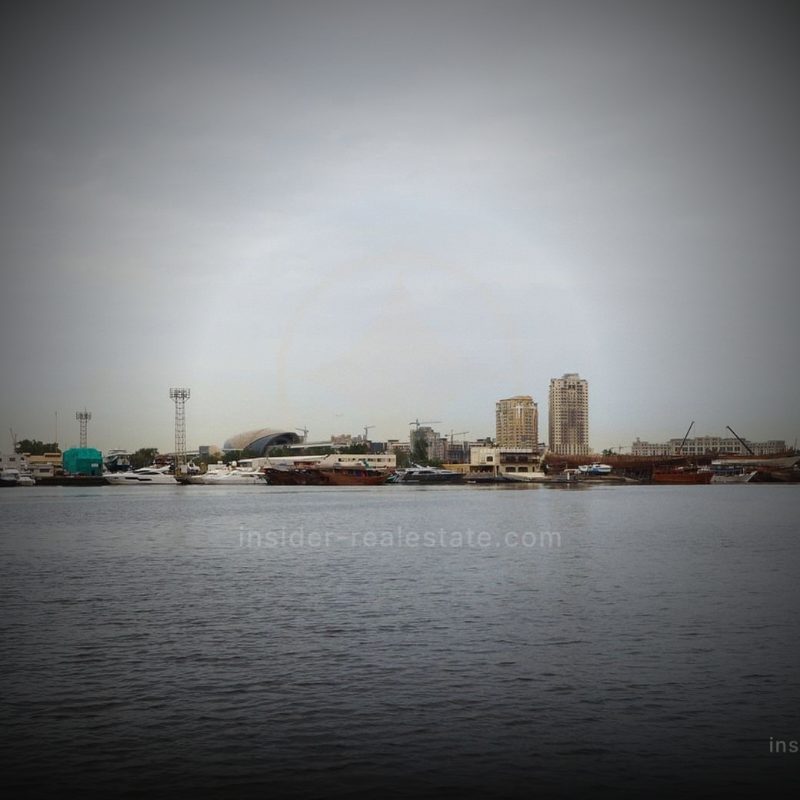
The Dubai Water Canal opened in November 2016. A 3.2-kilometre channel extended Dubai Creek from Business Bay through Al Wasl and out into the Arabian Gulf by Jumeirah beach.
Three bridges cross it, including the Sheikh Zayed Road crossing with its artificial waterfall, which switches off when a vessel passes underneath. Pedestrian promenades run along both banks for roughly six and a half kilometres in total.
Engineering-wise this is a rare operation for the city: not landfill, not a new district on empty ground, but water driven through already built, already expensive territory. That is exactly why the market effect was so abrupt.
What the canal did to the market
Before 2016 waterfront in Dubai came in two forms: the sea and Dubai Creek. Everything else was inland, and the gap between a water view and a view of the next building ran to multiples.
The canal added more than six kilometres of frontage in the middle of the city, where the land was already built on and already expensive. Buildings that stood in inland blocks found themselves on a promenade overnight.
For Business Bay that changed the positioning wholesale: a dense district of commercial towers acquired a waterfront and, with it, a different class of tenant. For Al Wasl and Jumeirah it added a waterside dimension to what had been ordinary city blocks.
Who benefits today
Owners of units with a direct water view. The premium over comparable apartments in the same building is real and durable, because it cannot be reproduced: frontage is finite.
Short-let operators. A promenade with restaurants and a walking route is something guests pay for, and the word "canal" works in a listing much the way "beach" does.
And buyers deeper inside the blocks, though differently. Walkable access to the promenade lifts the whole district: where people can step out and walk, tenants stay longer, even when the window faces a courtyard.
Where the effect stops
Abruptly. A water view belongs to specific lines of buildings and specific orientations, not to a district. Between two towers of the same development the price difference can be a multiple — and that is the correct difference, not an overpricing.
The second limit is construction. A new building can rise between your window and the water in Business Bay: empty plots remain, and today's open view can become tomorrow's view of a facade.
The third is the promenade itself. It is not uniform: parts are landscaped and lined with restaurants, parts remain a service strip. Fifteen minutes walking the bank before you buy explains more than any render.
What to check before buying
The view from the specific apartment, not from the building. Angle, floor and what stands opposite decide more here than the address or the floor area.
The empty plots in the line of sight, and what is permitted on them. In Business Bay that is the single most common reason a purchased view disappears three years later.
The service charge. Waterside buildings carry more common areas, and the promenade and landscaping around them need maintaining; on a cheap unit that line eats a noticeable share of the yield.
How the canal fits the rest of the centre
Business Bay remains the densest and most varied stretch: expensive units with direct frontage, ordinary tower apartments inside the blocks, and a spread between them wider than the spread between districts.
Al Wasl and Jumeirah offer a different format — low-rise and villas near the water, at a higher entry price and with a much thinner supply.
Al Jaddaf and MBR City adjoin the same water system from the Creek side: similar logic, an earlier stage of development, a lower entry price.
Each of these is covered with median prices and current stock composition in the Dubai areas section.
What the canal did not change
Traffic. Water is not a road: the canal shortened no commute and relieved no junction. Business Bay queues at peak exactly as it did, and the water taxi remains a leisure format rather than a way to get to work.
It also did not erase the difference between the centre and the sea. Canal frontage is not Gulf frontage: there is no beach here, and a buyer who wants the sea is not satisfied by a canal.
Nor did it change what Business Bay is. The district remains commercial by designation and towered by construction: offices, apartments and not much else. The promenade added a walkable layer; it did not turn it into a residential quarter with schools and courtyards, as presentations sometimes suggest.
Finally, it did not make the water accessible to everyone. Only a limited number of buildings open directly onto the promenade; the rest are separated from it by a road or another plot. The phrase "on the canal" covers both cases, and the price difference between them is substantial.

 Dubai Metro
  Burj Khalifa
  Al Maktoum International
  Dubai Tram
  The Dubai Mall
  Etihad Rail
  Dubai International (DXB)
  Jebel Ali Port
  Sheikh Zayed Road
  Expo City Dubai
  Dubai Creek
  Museum of the Future
  Ain Dubai
  Mall of the Emirates
  Dubai Hills Mall
  Palm Monorail
  Infinity Bridge
  Metro Gold Line
  DIFC Zabeel District
  Dubai Opera
  The Dubai Fountain